
From Bosnia to the Bar Council: Kirsty Brimelow KC on What Pro Bono can actually achieve

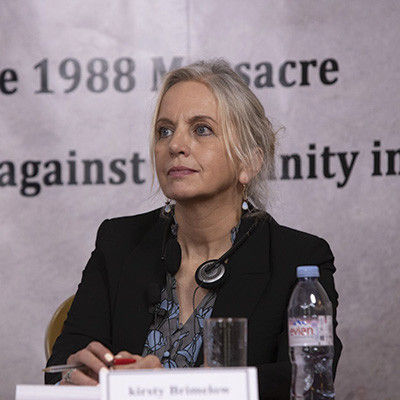
Kirsty Brimelow KC - Deputy High Court judge, elected Chair of the Bar Council, and one of the most prominent human rights barristers practising at the English Bar - recently visited LSE to speak to the Law Society's Pro Bono Division. What followed was a rare account of a legal career built, in large part, around pro bono work: not as a supplement to practice, but as its animating force.
Brimelow did not arrive at human rights law in a straight line. She began her pupillage at Littleton Chambers, a civil law set, and came to human rights advocacy through a gradual deepening of her practice - a trajectory she described not as a detour but as an accumulation. Her instinct toward pro bono predated the Bar entirely. At university she was already involved in charity work, including taking children into the City; she later worked at a homeless shelter. In the early years of her practice, she advised a charity delivering food in Bosnia. These were not calculated career moves. They were, she suggested, expressions of a commitment that preceded any career calculation. The pivot toward more structured human rights advocacy came when she joined the Bar Human Rights Committee, eventually serving as Vice Chair and then Chair over a period of six years. But the moment she identified as genuinely formative was a two-year engagement on death row cases in Jamaica - an experience that clarified, in ways that domestic practice rarely can, what international advocacy at its most serious looks like.
Witchcraft, Colombia, and the Reach of International Law
The cases Brimelow described at LSE were not abstract. One of the most striking threads of her career has been her work protecting children stigmatised as witches - a phenomenon she first encountered while working in Nigeria. The practice of labelling children as witches, and the abuse that often follows, is not confined to any single country or religion; it surfaces across cultures and continents, and it rarely attracts the attention of domestic legal systems equipped to address it. Brimelow's response was characteristic: she built a coalition. Teaming up with academics at universities including Lancaster and institutions in Sydney, she assembled the kind of cross-disciplinary, cross-jurisdictional evidence base that the UN requires before it moves. The culmination of that work contributed to UN-level protections for children subject to harmful belief practices - the kind of outcome that takes years, involves no courtroom in the conventional sense, and produces no fee note. It is also, she implied, the kind of outcome that stays with you. The Colombia engagement was different in character but equally vivid. In 2018, Brimelow travelled to San José de Apartadó (a community of cacao farmers) as part of a fact-finding investigation. The visit concerned the 1999 El Tigre massacre, in which right-wing paramilitaries tortured and killed approximately 50 people suspected of sympathising with rebels. The work she and others conducted contributed to a historic moment: Colombian President Juan Manuel Santos issued a formal state apology to the victims, saying (in words that Brimelow quoted at LSE) "Not only is the State asking for forgiveness, but I am asking for forgiveness." That a pro bono fact-finding mission could form part of the chain of events leading to a presidential apology is not a small thing. Brimelow described it as one of the most meaningful experiences of her career.
Pro Bono as Craft, Not Charity
What distinguished Brimelow's account from the more familiar narrative of pro bono as corporate social responsibility was her insistence on the craft it demands. The skills she described as central to her practice - above all, the capacity to listen - are not soft embellishments to legal work. In the context of trauma, across cultures, with clients for whom the legal system is alien and often threatening, the ability to hear someone's perspective without imposing your own framework is, she argued, a technical competence as much as a human one. Her work now includes a focus on trauma-informed training, recognising that how lawyers receive testimony shapes the quality of what they receive. She was equally clear-eyed about the limits of pro bono and its relationship to legal aid - a subject on which, as elected Chair of the Bar Council, she carries institutional weight. Pro bono, she said plainly, is not a replacement for legal aid and should never be treated as one. Increasing access to legal aid remains essential, particularly in areas like domestic abuse, where she argued that provision should not be means-tested but automatic. The declining funding of legal aid is a structural problem that structural solutions must address; pro bono fills gaps but cannot substitute for a properly funded system.
The Bar Council and What Comes Next
Brimelow's election as Chair of the Bar Council - a position she holds by democratic vote of the profession - gave an institutional dimension to her pro bono commitments. She described her human rights and pro bono experience as directly shaping her leadership, giving her a vantage point on the justice system that a purely commercial career would not have afforded. At LSE, she was asked about the Leveson Review and current proposals to reduce the availability of jury trials for offences carrying sentences of up to three years - a measure proposed primarily to address the considerable backlog in the Crown Court. Her objections were both principled and pragmatic. On principle: juries feature in only one to three percent of cases, but their constitutional significance is not proportional to their frequency; removing them for a category of cases that includes dishonesty, disorder, and protest offences represents a meaningful erosion of a fundamental right. On pragmatics: judge-only trials are, on the available evidence, only around twenty percent more efficient, a modest gain against a significant cost.
For law students in the room considering advocacy, her advice was direct: network deliberately, get involved early, and include pro bono work in any application - including, as she noted from her own experience, a KC application. The value of pro bono, she suggested, is not merely what it does for others. It is what it does for the lawyer who does it.


Comments